
If you freelance, the IRS does not wait until April. It expects four payments a year, and the penalty for guessing wrong is real. Here is the cheat sheet we wish every 1099 worker had taped to their monitor: due dates, the safe harbor that lets you stop sweating projections, the self-employment math W-2 workers never see, and a clean rule for what to pull out of every invoice.
When estimated payments are required

The IRS requires quarterly estimated payments any time you expect to owe $1,000 or more in tax after subtracting withholding and credits. That threshold catches almost every full-time freelancer and most side-hustlers clearing a few thousand a month. Corporations have a separate $500 trigger, but for sole proprietors and single-member LLCs the rule is the $1,000 line.
Skip a payment and the IRS charges an underpayment penalty calculated quarter by quarter, not annually. A balance due in April does not "cure" a missed June. Each quarter stands alone, which is why people who pay everything at year-end still get hit with penalty notices.
The four due dates

2026 has no weekend or holiday shifts. Every date lands on a business day, so the standard schedule applies:
- Q1 2026: Wednesday, April 15, 2026 (covers January through March income)
- Q2 2026: Monday, June 15, 2026 (covers April and May)
- Q3 2026: Tuesday, September 15, 2026 (covers June, July, August)
- Q4 2026: Friday, January 15, 2027 (covers September through December)
Notice that the "quarters" are not actually three months each. Q2 is two months, Q3 is three, Q4 is four. The IRS labels them quarters anyway. If a due date ever falls on a Saturday, Sunday, or legal holiday, payment is timely the next business day, but none of the 2026 dates trigger that rule.
Safe harbor: the rule that beats every tax calculator
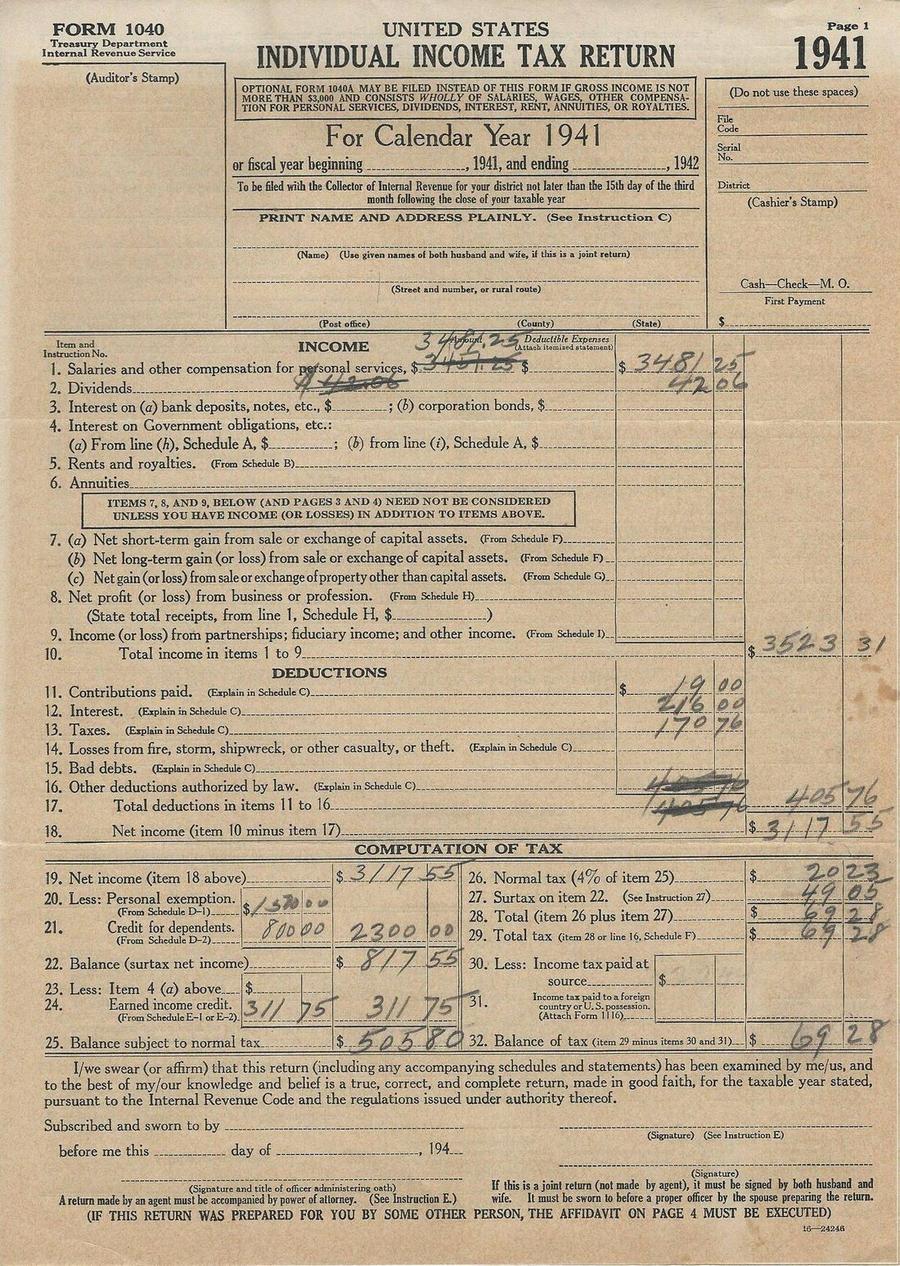
Projecting current-year income is hard. Freelance revenue swings, clients ghost, a big invoice arrives in November and blows the model up. The IRS gives you a way out called safe harbor. Pay one of these amounts across the four quarters and you owe zero penalty, regardless of what your final tax bill turns out to be:
- 90% of your current-year (2026) tax liability, or
- 100% of your prior-year (2025) tax shown on the return, or
- 110% of your prior-year tax if your 2025 AGI exceeded $150,000 ($75,000 if married filing separately)
The prior-year option is the magic one. Look at line 24 of your 2025 Form 1040. Divide by four. Pay that on each due date. The IRS cannot assess an underpayment penalty even if you make ten times more in 2026, because you cleared safe harbor on day one. You will still owe the balance in April 2027, but no penalty interest gets tacked on.
This is why "safe harbor" beats any in-quarter projection tool. A tool guesses. Safe harbor is a fixed number from a return you already filed.
Self-employment tax (the part W-2 employees forget)
On a W-2, your employer pays half of Social Security and Medicare. You pay half. As a freelancer, you pay both halves. That is self-employment tax, and it is 15.3% of net earnings up to the Social Security wage base, then 2.9% above it.
The breakdown:
- 12.4% Social Security on net SE earnings up to the wage base ($176,100 in 2025; $184,500 in 2026 per the Social Security Administration October 2025 announcement)
- 2.9% Medicare on all net SE earnings, with no cap
- Additional 0.9% Medicare on earnings above $200,000 single, $250,000 married filing jointly, $125,000 married filing separately
SE tax is calculated on 92.35% of your net earnings (the IRS lets you back out the employer-equivalent half before applying the rate). You also get to deduct half of the SE tax you paid as an above-the-line adjustment on Form 1040. That deduction reduces your income tax, not your SE tax.
A freelancer netting $80,000 owes roughly $11,304 in SE tax alone before any income tax is calculated. That is the number most new freelancers miss when they look at gross revenue and feel rich.
What to set aside

The right percentage depends on income tier and filing status, but here is a working starting point. Pull this percentage from every client payment into a separate savings account the moment it lands. Reconcile against safe harbor at each quarterly deadline.
| Net SE income (single filer) | Set aside | Safe harbor rule that applies |
|---|---|---|
| $0 to $40,000 | 22% to 25% | 100% of prior year tax |
| $40,000 to $80,000 | 25% to 30% | 100% of prior year tax |
| $80,000 to $150,000 | 30% to 33% | 100% of prior year tax |
| $150,000 to $200,000 | 33% to 36% | 110% of prior year tax (AGI over $150k) |
| $200,000+ | 36% to 40% | 110% of prior year + 0.9% Add'l Medicare |
State tax stacks on top. Add 5% for low-tax states (Colorado, Pennsylvania), 8% to 10% for high-tax states (California, New York, Oregon). Zero-tax states (Texas, Florida, Washington, Tennessee, Nevada, South Dakota, Wyoming, Alaska) skip this layer entirely.
Two operational rules we live by at Savvynomics. First, every invoice gets split the day it clears: tax savings out first, then the rest is yours. Treating gross revenue as income is how freelancers end up owing $18,000 in April with $400 in checking. Second, run safe harbor math in January when last year's 1040 is fresh. Four equal payments based on that one number is less work and less stress than projecting current-year income every quarter.
Quarterly Tax Calculator
2026 IRS brackets, safe harbor calc, due-date schedule, SE tax. Excel and Google Sheets.
The Money Memo
One short email a week. The math, the moves, the corrections. No spam.
Sources
- About Form 1040-ES, Estimated Tax for Individuals, IRS (verified May 2026)
- Estimated Taxes (small businesses and self-employed), IRS (verified May 2026)
- Publication 505, Tax Withholding and Estimated Tax, IRS (verified May 2026)
- Self-Employment Tax (Social Security and Medicare Taxes), IRS (verified May 2026)
- Questions and Answers for the Additional Medicare Tax, IRS (verified May 2026)
- Contribution and Benefit Base (Social Security wage base), Social Security Administration (verified May 2026)